


Roles & Responsibilities in a Modern Household
- emilyklein
- Sep 11, 2025
- 4 min read

A few weeks back, as summer ended and kids headed back to school, I noticed many of my conversations kept circling back to one theme: the roles that women and men take on in their households. And the thing I kept coming back to is this — it’s just not black and white anymore.
Not too long ago, when most women weren’t working outside of the home (or at least weren’t paid for the work they did), the division of labor was considered clear. Women were the homemakers — managing laundry, cooking, cleaning, and raising children. Men worked outside the home, bringing home a paycheck, and often arrived back just in time for dinner.
Fast forward to today, and things look very different. Women have more opportunities than ever. Many choose to work outside the home, and many others need to. Some men now stay home with the kids, and in many households both partners work full time. Even without children in the mix, this raises questions:
If both partners work all day, who cooks dinner?
Who’s doing the laundry?
Who’s paying the bills or handling the accounting?
Add children to the equation, and the questions multiply:
Who stays home when the baby is sick?
Will the kids go to daycare?
Who plans after-school schedules, packs lunches, and remembers the ever-evolving grocery list?
Who gets up in the night with the baby?
The list ebbs and flows, and the answers aren’t simple.
My Own Experience
In the early years of parenting, especially those first five, I often felt overwhelmed. My husband and I were learning how to move from being independent adults to a team with new responsibilities. Much of our tension came from negotiating time and energy:
“You had 90 minutes to surf; I only got 45 for yoga.”
“I’ve been home all day with the baby. I love it, but I’m exhausted — can you make dinner?”
“I only had time to myself during the nap, but I spent it cleaning.”
“I was up three times last night — can you handle the laundry even though you worked all day?”
The list went on. Some months were harder than others, especially when the kids were sick or hitting new stages. Once I started working outside the home, things got even more complicated. We would find good rhythms sometimes, and other times it felt like we were constantly renegotiating.
Another challenge is that many families no longer live close to extended relatives. The old “village” mentality — where grandparents, aunts, uncles, and neighbors pitched in — isn’t as present.
Listening Beyond My Home
After years of reflecting on this — and after watching many of my younger friends go through the same struggles — I decided to put out a survey. My goal was simple: take the pulse of the broader community. How do people really feel about the division of household labor today? And maybe, just maybe, some households have found systems that work that could inspire others.
What the Survey Revealed
100% of respondents had kids
95% were female
79% had been married 10 years or longer
Who Cooks?
Mostly me (mom): 54.5%
Always me: 11.4%
Shared equally: 15.9%
Mostly my spouse: 18.2%

➡️ Two-thirds of households reported that mom does most or all of the cooking.
Who Cleans?
Mostly/Always me: ~70–75%
Shared equally: ~20%
Mostly spouse: ~5–10%

➡️ Cleaning was one of the most unevenly shared tasks.
Who Does the Grocery Shopping?
Always/Mostly me: ~50%
Shared equally: ~40%
Mostly spouse: ~10%

➡️ Grocery shopping leaned more balanced than cooking or cleaning.
Who Coordinates Kids’ Schedules?
Always me: 51%
Mostly me: 32%
Shared equally: 15%
Always my spouse: 2%
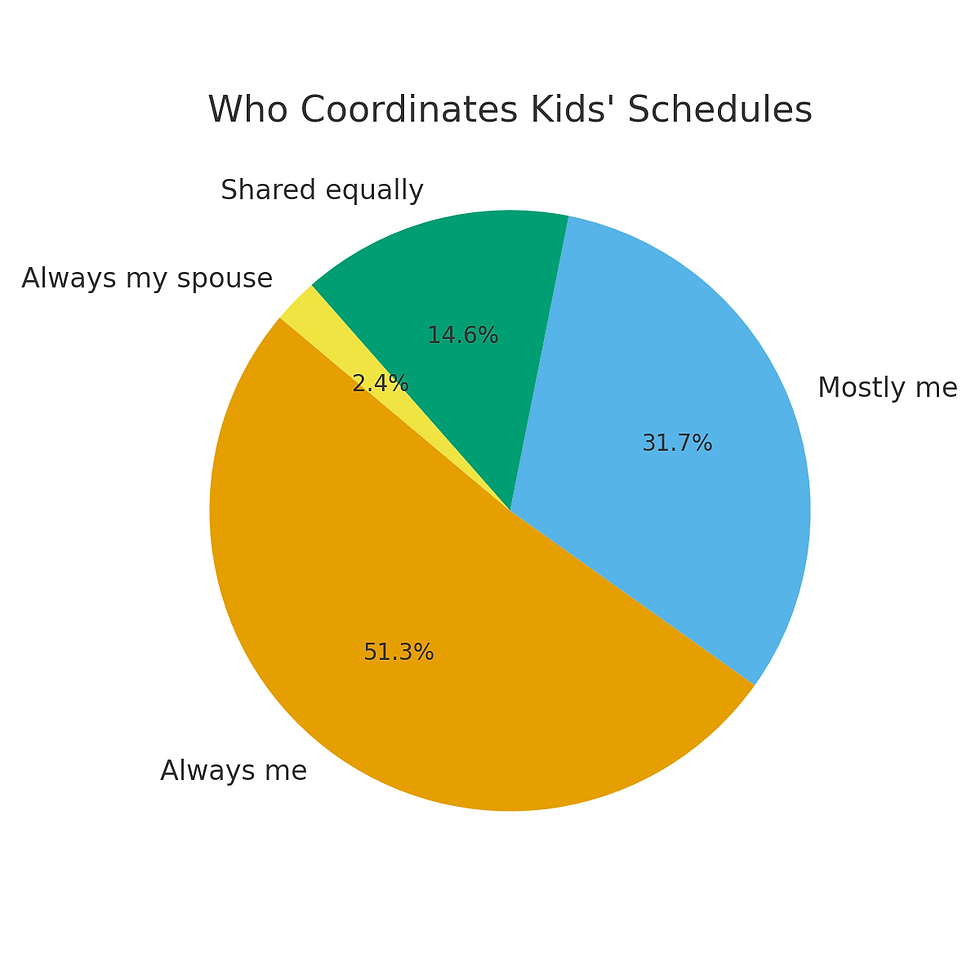
➡️ This was the most dramatic imbalance — moms overwhelmingly take on the “mental load” of scheduling.
Do Families Feel It’s Fair?
When asked whether household roles feel balanced and fair:
Yes: ~10%
Mostly fair (with caveats): ~15%
No: ~60%
Depends on the day: ~15%

Many “no” responses highlighted invisible labor: planning, remembering, emotional load, and mental stress.
Voices From the Survey
Validation — Moms Carrying the Load
“No. Never. As long as we both work but I take on the nurturing, motherly role … I do more cooking, cleaning, laundry, school coordination, and chauffeur to sports.”
“Depends on the day… it fluctuates but I do feel like I carry the heavier load.”
“The mental load is basically 99% on me and that’s exhausting for sure.”
Themes From Families Who Feel Balanced
Divide by Strengths or Roles
One partner cooks, the other does dishes.
One manages inside chores, the other takes on yard/cars/repairs.
People lean into what they’re naturally better at or less resistant to.
Flexibility & Adaptation
Roles shift depending on who’s busier that week or season.
Ongoing lists where whoever has more capacity jumps in.
Recognizing that “balance” looks different at different times.
Clear Communication
Couples regularly ask each other: “How can I help?”
Systems built from years of talking, trial and error, and adjustments.
Setting expectations early (like when kids were born) to avoid resentment later.
Mindset & Reframing
Viewing chores as rituals or gifts rather than burdens.
Letting go of perfectionism/control so others can step in.
Focusing on teamwork and love-in-action rather than fairness as a scorecard.
Kids as Contributors
As children grow, they’re included in household responsibilities.
Families customize chores to kids’ strengths (e.g., one does trash, one handles dishes).
These themes show that “fair” doesn’t mean perfectly 50/50. It’s more about communication, flexibility, and intentional systems that evolve with time.
The Big Theme
Even when chores are split, moms often carry the invisible load — the planning, remembering, and coordinating. This isn’t about shame or blame, but about recognition. When the invisible becomes visible, conversations can start.
Where Do We Go From Here?
Instead of sweeping it under the rug, let’s keep the dialogue alive. Some gentle prompts you might bring to your own household:
How can we make invisible work visible?
What’s one small swap we could try this week?
How do we bring this up without it turning into blame?
Having a weekly date or family meeting (if the kids are old enough) and look at the lists and necessary chores. Come up with a balanced and "fair" division of meals, cleaning, etc etc....
This isn’t about pointing fingers. It’s about co-creating solutions that bring more balance, joy, presence and partnership into the home.


Comments